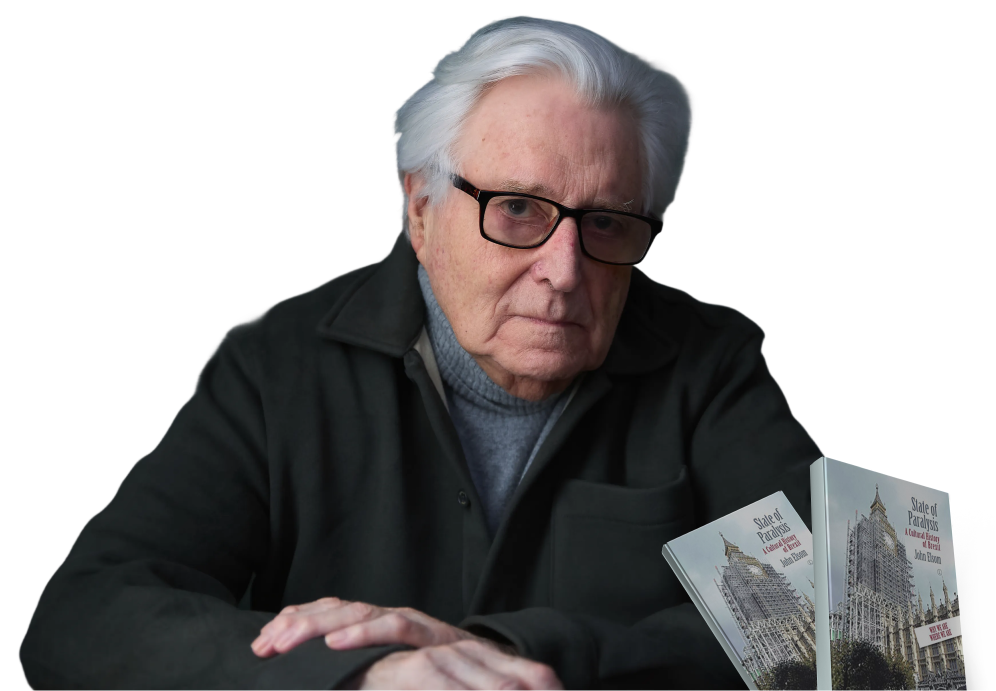
For over six decades, John Elsom has written with clarity, depth, and authority on theatre, politics, cultural policy, and modernity. His books are cited internationally, taught at universities, and read by historians, artists, and students of contemporary politics.
INTELLIGENT – INFORMED – INCISIVE
the voice of reason in a deluded world
Professor John Pick, Arts Economist
Dr. John Elsom is a writer, theatre historian, cultural critic, and international arts consultant. He has worked as a theatre critic for the BBC, served as arts editor for The World & I magazine in the United States, and chaired the International Association of Theatre Critics, a UNESCO-affiliated organization.
He has advised governments, universities, and cultural institutions across Europe, Asia, and North America and has received international awards for his contribution to culture during and after the Cold War.

A novel
Ten Stories about the intuitive and irrational.
Collected Plays
A moving and insightful musical exploring love, loneliness, immigration, and emotional vulnerability in modern London. Through humour, music, and deeply human relationships, the story examines power, connection, and the complexities of starting over after heartbreak.

Culture and politics
Sliding Scales: The Uncertain History of Modern Democracy
An engaging and thought-provoking exploration of democracy, political systems, and the evolution of modern governance. Blending history, philosophy, and contemporary analysis, the book examines how ideas of freedom, equality, and power continue to shape societies across the world.

A novel
How to Succeed in the World of AI.
Big DaDa
BIG DADA and the Paradiseville Experience is a bold, imaginative, and darkly humorous literary work that blends satire, mystery, and social observation into a uniquely immersive reading experience. With its distinctive voice and layered storytelling, the novel invites readers into a world that is both familiar and unsettling, exploring ambition, identity, power, and the unpredictable nature of modern society.

A novel
Ten Stories about the intuitive and irrational.
World Within
World Within is a compelling collection of imaginative and thought-provoking stories that explore the complexities of belief, identity, human relationships, and the unseen forces that shape our lives. Blending sharp observation with literary depth, John Elsom creates a richly atmospheric reading experience that challenges perspectives while remaining deeply human and engaging.
New Works – 2026
John Elsom’s upcoming works for 2026 continue his exploration of politics, society, identity, and the human condition through a diverse collection of fiction, drama, and non-fiction. From thought-provoking political commentary in Sliding Scales to the imaginative storytelling of World Within and BIG DADA and the Paradiseville Experience, these new manuscripts showcase a distinctive literary voice that blends intellect, satire, philosophy, and emotional depth. His latest musical work, Second Time Round, further reflects his ability to capture complex human relationships with warmth, humour, and insight.
Theatre

Post-War British Theatre
(Routledge, 1976 & in Routledge Revivals, 2015)

The definitive account of British theatre from 1945 to the mid-1970s, Elsom traces the seismic shifts that reshaped the stage.
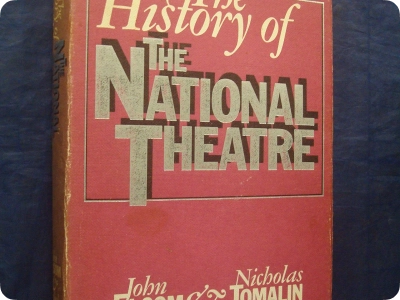
The History of the The National Theatre
(with Nicholas Tomalin, Cape, 1978)
A comprehensive history of the National Theatre from its origins to its first years at the South Bank.

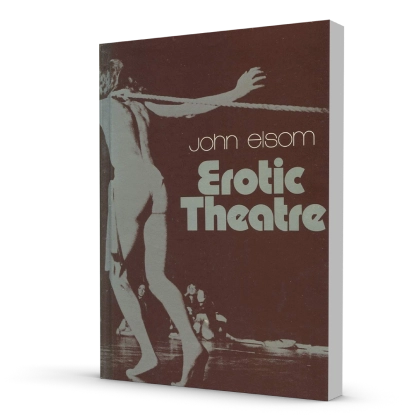
Erotic Theatre
(Secker (UK), 1973, Taplinger (US) 1974 and Dell (US) 1974)
A study of sexuality and the stage not as scandal or titillation, but as a serious critical enquiry into how theatre.

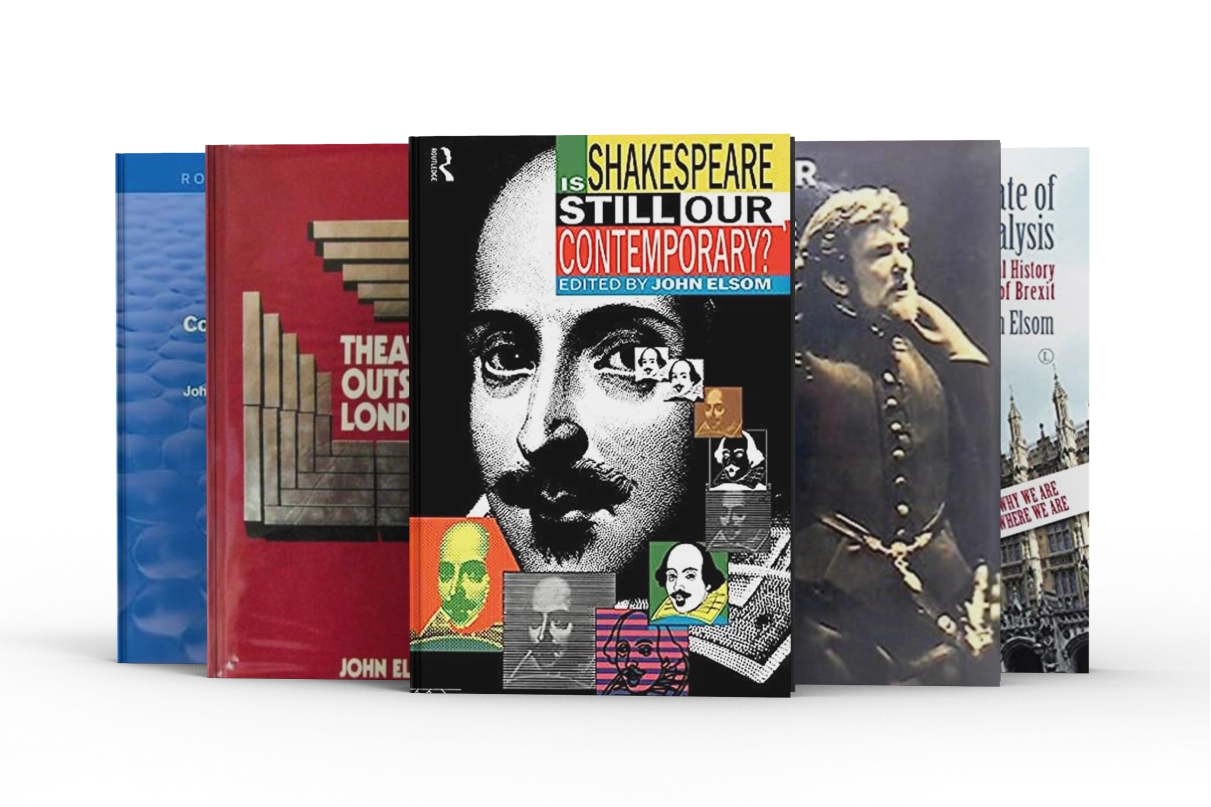
Theatre Outside London
(Macmillan, 1971) – a study of the British Repertory movement
A survey of the flourishing regional theatre movement that was transforming British cultural life beyond the capital.

Post-War British Theatre Criticism (Ed.)
(Routledge, 1981 & in Routledge Revivals, 2015)
An edited anthology of the best British theatre criticism from the post-war decades.

Cold War Theatre
Routledge, 1992, and re-issued 2014
Between the end of World War II and the fall of the Berlin Wall, theatre on both sides of the Iron Curtain was a battlefield for ideas.

Is Shakespeare Still
Our Contemporary
– Routledge, 1989 –
First posed by the critic Jan Kott in 1964, the question of Shakespeare’s contemporary relevance has never been answered.

The world and I
As fine and thoughtful a theatre critic as you will find anywhere,” Michael Marshall, Managing Editor, The World & I, US monthly magazine.
In 1979, John joined the International Association of Theatre Critics (IATC/AICT), a UNESCO NGO (Non-Governmental Agency), which brings together those (world-wide) who write about the theatre – journalists, academics, and literary managers. The Cold War, which had dominated international relations since the end of WW2, was coming to an end. Following a period of détente, the barriers that separated East from West were broken down, culminating in the destruction of the Berlin Wall in 1989. John was elected in Mexico as an IATC Vice-President in 1984, and as world President in Rome in 1985, a role that he retained until 1992, twice re-elected. His aim was to overcome the decades of Cold War hostilities, encourage the appreciation of diverse cultures, and to support conferences and festivals.
culture and politics
Exploring the intricate relationship between cultural movements and political shifts, this section delves into how societal values shape power dynamics and vice versa.

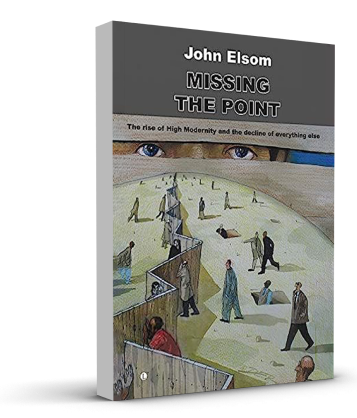
Missing the Point: The Rise of High Modernity and the Decline of Everything Else
A sweeping cultural diagnosis of the late twentieth century and its discontents. Elsom argues that Western societies have progressively lost.

State of Paralysis
State of Paralysis is the study of the forces that prevents Western democratic institutions from responding effectively to the challenges.
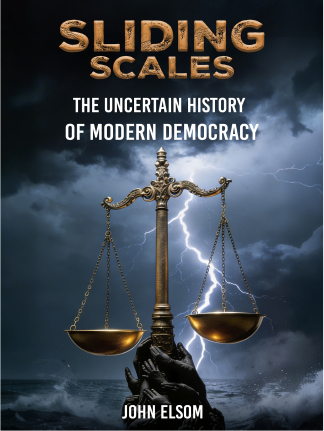
Sliding Scales: The Uncertain History of Modern Democracy
From the Athenian agora to the algorithmic present, democracy has never been what its defenders claimed or its critics feared.
Missing the Point: The Rise of High Modernity and the Decline of Everything Else
A sweeping cultural diagnosis of the late twentieth century and its discontents. Elsom argues that Western societies have progressively lost.
State of Paralysis
State of Paralysis is the study of the forces that prevents Western democratic institutions from responding effectively to the challenges.
Sliding Scales: The Uncertain History of Modern Democracy
From the Athenian agora to the algorithmic present, democracy has never been what its defenders claimed or its critics feared.

Contemporary Review
One of Britain’s oldest and most respected journals of opinion, Contemporary Review was founded in 1866 and counted Ruskin, Gladstone, and Aldous Huxley among its contributors.
State of Paralysis
State of Paralysis is the study of the forces that prevents Western democratic institutions from responding effectively to the challenges they face be it from the structural inertia of parliamentary systems.
Performance

The Well-Intentioned Builder
Cockpit Theatre, London, 1966; National Theatre of Craiova, Romania, 2004.
A woman calls a builder to fix a damp patch in her childhood nursery.
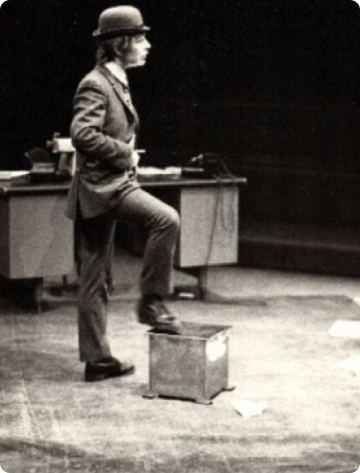
One More Bull
Cockpit Theatre, London, 1966
A sharp, comic piece staged at the Cockpit Theatre in 1966.

The Man of the Future is Dead
Edinburgh Fringe Festival, 2006; Bulandra Theatre, Bucharest, 2007
A meditation on utopia, disappointment, and the gap.

Old Boy
Tristan Bates Theatre, London, 2009
Produced by Anthony Field Associates at the Tristan Bates Theatre.
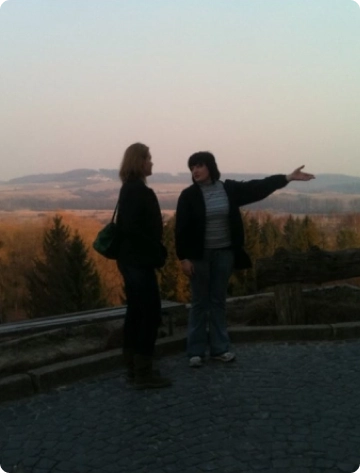
Second Time Round
International Festival of Musical Theatre, Bucharest, 2007; London, 2011
A musical with music by composer Wayne Warlow.

Peacemaker
ADC Theatre, Cambridge – 1956

Maui
Libretto for the opera by Barry Anderson, 1958

The Turning World
Unteatru, Bucharest – 2011

Malone Dies
Edinburgh International Festival
(and on tour) – 1984
Adapted and directed by Elsom from Samuel Beckett’s novel for the comic actor Max Wall, Malone Dies was staged at the

Hedda Gabler
Edinburgh Fringe Festival – Aug 2006 – Bulandra Theatre – 2007
John’s adaptation of Ibsen’s masterpiece was staged at the Edinburgh Fringe in 2006 and at the Bulandra Theatre


Journalism
‘…the first rough draft of history.’
Philip L. Graham, former Washington Post President
The world and I
As fine and thoughtful a theatre critic as you will find anywhere,” Michael Marshall, Managing Editor, The World & I, US monthly magazine.
In 1979, John joined the International Association of Theatre Critics (IATC/AICT), a UNESCO NGO (Non-Governmental Agency), which brings together those (world-wide) who write about the theatre – journalists, academics, and literary managers. The Cold War, which had dominated international relations since the end of WW2, was coming to an end. Following a period of détente, the barriers that separated East from West were broken down, culminating in the destruction of the Berlin Wall in 1989. John was elected in Mexico as an IATC Vice-President in 1984, and as world President in Rome in 1985, a role that he retained until 1992, twice re-elected. His aim was to overcome the decades of Cold War hostilities, encourage the appreciation of diverse cultures, and to support conferences and festivals.

The London Magazine
During the 1960s, John was the theatre correspondent and talent scout at Paramount Pictures; and taught part-time at the City Literary Institute, Drury Lane, London, where he started a theatre group. He contributed articles mainly on the theatre to The London Magazine, then edited by the poet and cricket correspondent, Alan Ross. This was London’s leading cultural magazine, founded in 1732, which published poems, short stories, and social criticism, from a wide range of international writers.
Contemporary review
The Contemporary Review (CR), a monthly magazine, was founded in 1866 as a vehicle for the growing community of writers who sought to express their hopes for a brave new world, transformed by science, democracy, and the Industrial Revolution. It was ‘left-of-centre’, with unofficial links to the Liberal Party, progressively Christian, or humanist in outlook. Its early contributors included John Ruskin, W.E. Gladstone, Matthew Arnold, J.M. Barrie, and Aldous Huxley.
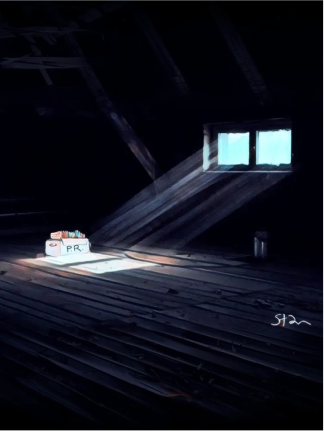
Clearing out the attic: why our political system needs a complete re-think
PR, Lord’s reform, Gordon Brown’s ‘people’s convention’: they have their merits, says John Elsom, but we need to go further
The Catch-22 of electoral reform under the British system is that you must win a parliamentary majority by first-past-the-post before you can introduce proportional representation (PR). By some quirk of nature, this is rarely the priority of a party that has just got into power. Reforming zeal evaporates. They hum and haw. There may be a case for a fairer system, they concede, but there are more urgent matters in their in-trays, and their government should lead from the front and not be distracted by constitutional niceties …
Books That Sell – How to Buy
Start Reading Today
John Elsom’s books are available worldwide through multiple channels.

Direct & Retail
Buy directly from publishers or order through major online retailers like Amazon and Bookshop.org.

Academic & Library
Available for institutional purchasing and library acquisition via major distributors.

Learn More
Each book page includes detailed descriptions, press reviews, and intended readership information.
Stay Informed
News & Updates
Begin with the Books That Matter
Discover works that challenge assumptions, illuminate culture, and remain relevant across generations.